Friday, December 4, 2015

Slow and Steady for the Desert Tortoise

Slow and Steady for the Desert Tortoise

By: Cesar Sanchez


Habitat of the Mojave Desert Tortoise

The species of Desert Tortoise scientifically referred to as Gopherus agassizii, is found in the Mojave Desert located in the western parts of Arizona, southeastern California and southwestern Utah. 

Geographic Range of Mojave Desert Tortoise

   You will most likely not stumble upon a Desert Tortoise outside of its burrow, because it spends 95% of the year underground. While underground, the tortoise does not engage in much activity. This is to preserve the amount of water they use, and burrowing underground is a great way to escape the scorching sun and prevent evaporation of they water in and on their body. The sun can be seen as an opponent of the tortoise, and because of this it is essential that a tortoise can burrow underground. The claws on their front feet are especially made for digging into dirt that is friable enough to dig and strong enough to not collapse. 
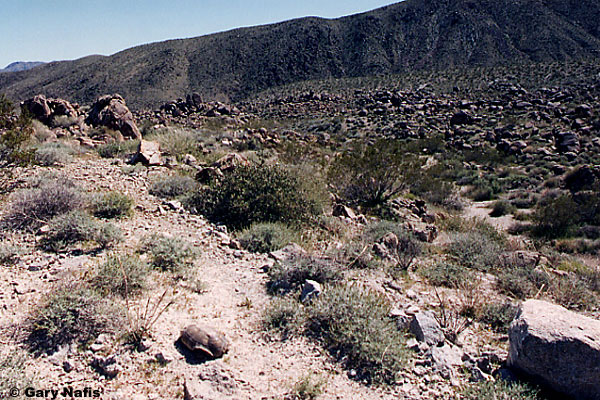
Tortoise in habitat in Riverside, CA


Home Sweet Home!


FUN FACT
The Ground temperature in the Mojave Desert can reach up to 140 degrees Fahrenheit!


Description

The desert tortoise can range in length from 10 to 14 inches and heights from 4 to 6 inches. Males are typically larger due to the fact that they must compete with other males for mates. They also have a larger gular horns located on their throats and they have larger tails. The top part of their shells are higher domed for males, the reason for this, in the event of being turned over, a larger dome allows for a better chance of flipping over. Typically they are greenish-tan in color or dark brown. Perfect camouflage from predators. 
Female looking on in shock 
Two males fighting over her
Notice the horns on their neck. These are meant for these situations and made for flipping over an opponent.


Reproduction

Tortoises take about 15 to 20 years to reach reproductive maturity. So in this sense the can be considered k selected species. Tortoises mate during the Spring and Autumn seasons, and during this time, males develop two white glands beneath their chin to signify mating season.
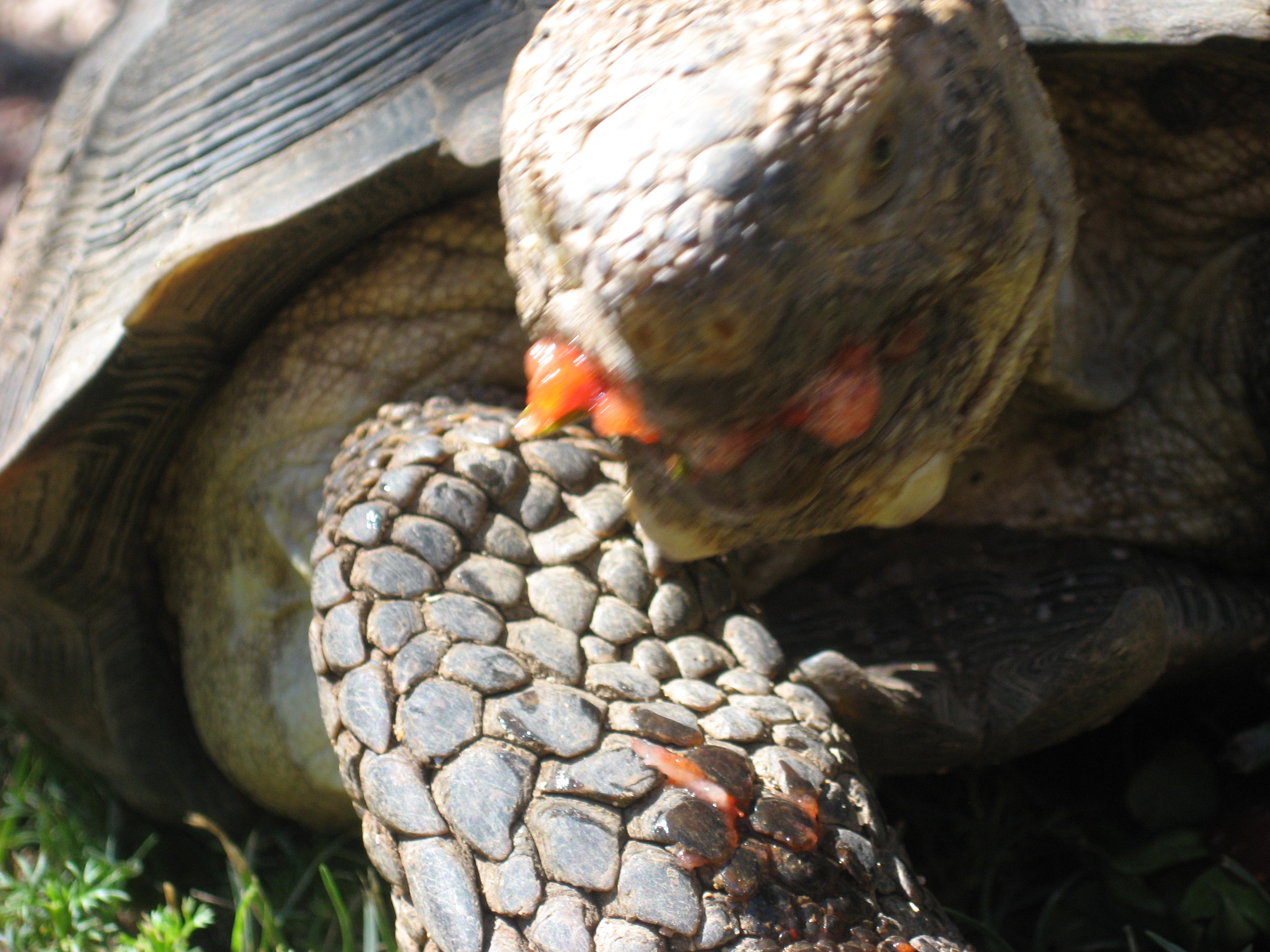
Male desert tortoise enjoying a strawberry with white glands beneath his chin.
Signifying he is ready to mate

You may google the mating process if you feel it will expand your knowledge of the Mojave Desert Tortoise. But if you don't feel the need, then let us move on.


A female can lay up to 4 to 8 eggs in their burrows, and they take about 135 days to hatch. Offspring have a very high infant mortality rate, and because of this they can also be seen as r-selected species. An estimated 2 to 5% of hatchlings reach reproductive maturity. :'(

Diet

The diet of a desert tortoise consists of grass and seasonal flowers. They may also eat cacti growing in their area along with their fruit. Desert tortoise gets a majority of their water from the plants they eat because of the lack of rain in the desert. You are more likely to catch a tortoise outside of its burrow after it rains because this is the right time to drink as much water as they can from small 
puddles. 
As you can see the wild desert tortoise is not even phased
the spikes on a cactus

YUMM!


FUN FACT
The Desert Tortoise is the state reptile of California.


Geographic and Population Changes

Indirect impacts to desert tortoise populations and habitat are also known to occur in areas that interface with intense human activity. In some areas the number of desert tortoises have decreased by 90% since the 1980s. Declines seem to be most severe in the western part of the Mojave Desert. Recent estimates indicate there are about 100,000 desert tortoises left in the Mojave and Sonoran Deserts. 
Tortoise cleverly avoiding traffic

Getting Put on the List

The Mojave population of the Desert Tortoise was listed under the Endangered Species Act as a Threatened species on April 2, 1990. The areas where they are founded was also listed as Critical Habitat in 1994 along with the the recovery plan being published in June of 1994. The desert tortoise was seen as having a moderate degree of threat, but with a very low potential for recovery. Largely because of their slow birthing rates and high infant mortality rates mentioned earlier. 


Main Threats to the Tortoise

Since the 1800s the desert southwest has been subject to a variety of activities that result in habitat fragmentation, degradation and loss. some of the more obvious reasons include road and highway development, and habitat invasion by non-native species. Off-highway vehicle activity, roads, livestock grazing, agricultural uses, and other activities contribute to the spread of non-native species and the direct loss and degradation of habitats. 

Desert Tortoise approaching a non-native grass species

Despite legal protection under Federal and State laws, deliberate maiming or killing of tortoises and collection of desert tortoises by humans for food or as pets were cited as potential threats to the species. 


Desert tortoises, particularly hatchlings and juveniles, are preyed upon by several native species of mammals, reptiles, and birds. The common raven has been the most highly visible predator of small tortoises, while coyotes have been commonly implicated in deaths of adult tortoises.


Desert toals, reptiles, and birds. The common raven has been the most highly visible predator of small tortoises, while coyotes have been commonly implicated in deaths of adult tortoises.
Elevated mercury  have been associated with diseased tortoises in the wild. Necropsy and analyses of kidney, liver, and scute tissues suggested that tortoises from California with a variety of diseases had statistically significantly higher levels of several potentially toxic elements as compared to healthy tortoises. Illegal dumping of hazardous wastes in the California deserts may expose tortoises to increased levels and possible consumption of toxic substances and affect populations on a localized level where these activities are concentrated 


Description of Recovery Plan

One main focus of the recovery plan is to keep the adults alive and reproducing as long as possible. Once adults have reached reproductive maturity, they are more likely to survive in the wild. If they do live longer then the current trends are saying, then they have a higher chance of reproducing more offspring. 

In 2000, Congress enacted the State Wildlife Grants Program to fund activities that benefit species of concern and their habitats. All four states where the Mojave population of the desert tortoise occurs are currently implementing these strategies to guide species and habitat management through 2015. 

Improved grazing management has been put into place to ensure the stopping of invasive plant species. 

In March 2008, about 650 tortoises were moved by helicopter and vehicle, up to 35 km away. The Desert Tortoise Preserve Committee roughly 5,000 acres of desert tortoise habitat from human activity. This area includes 4,340 acres in Kern County, 710 acres in San Bernardino County, and 80 acres in Riverside County.


Personal Action.

One thing us citizens can do to help continue the recovery of this threatened species is to not pick them up and take them home as pets. I know these are adorable and it may be hard to resist, but it is what is best for their survival. Also if you stumble upon one in the middle of the road, the best ting to do is safely move the animal away form the highway. Pull over to the side of the road or create a small road barrier and let drivers know that this threatened species is making their way across the road. 
It is our duty as Californians to help with the recovery process of our very own state reptile!
Slow and steadily this tortoise is making his way to recovery.

Resources
http://ecos.fws.gov/docs/recovery_plan/RRP%20for%20the%20Mojave%20Desert%20Tortoise%20-%20May%202011_1.pdf

http://www.californiaherps.com/turtles/pages/g.agassizii.html

http://animaldiversity.org/accounts/Gopherus_agassizii/

http://www.defenders.org/desert-tortoise/basic-facts


The Ocelot
by: Nicolas Rossi

Who is the Ocelot?


Add caption
The Leopardus Paradalis, more 
commonly referred to as the Ocelot, is a feline about double the size of the average house cat. Known for their beautifully dappled coat these nocturnal hunters can be seen preying on rabbits, rodents, lizards, and birds with their pointed fangs and sharpened back teeth. Unlike most felines they do not avoid water, as they can swim very well. Ocelot's have an average lifespan of 10-13 years in the wild and 20 years in captivity with their litters yielding one to three offspring. They can way up to 35 pounds, and be upwards of 4 feet long, and are divided into 11 subspecies based on different populations. For more information on the ecology of ocelots visit https://www.fws.gov/endangered/esa-library/pdf/ocelot.pdf.


Habitat And Population

Ocelots geographic range
Ocelots in the U.S.
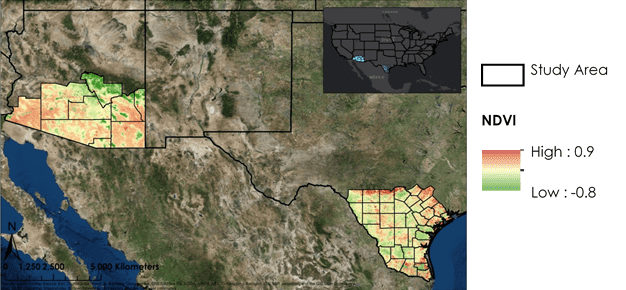
Ocelot’s can most often be found in subtropical areas, located from southern Texas, through Central America and into northern Argentina, with few spotted in Arizona.They inhabit various habitats ranging from humid tropical forests, savannas and dry scrub to swamp forests and coastal mangrove. They require dense vegetation, meaning upwards of 75% for a canopy cover, and 95% of shrub layer in Texas. While population of the Ocelot is an estimated 800,000 to 1.5 million globally, the Texas population resides at less than 50 Ocelots, found in two different populations in southern Texas, making them extremely endangered in the U.S.


Threats on Existence

Ocelot Pelt
The primary threat to Ocelots population, currently, are habitat conversion, fragmentation, and habitat loss. In Texas up to 95% of the shrub-land that the Ocelot once called home has been converted to agriculture, range-lands, and urban land use. This along with the isolation from other populations in Mexico causing inbreeding are the current reasons for the decline in ocelot populations. When originally listed, the Ocelot faced great threats of commercial exploitation along with illegal hunting. The ocelots highly sought after decorative coat resulted in many ocelots being slain for sake of fashion. Although minimal hunting continues, we have since seen the harvest and export of Ocelots decline as a direct result of CITES. (Convention on International Trade in Endangered Speies).


Recovery plan
Originally listed in 1982 the ocelot is listed as endangered throughout its range in the western hemisphere. The main goal of the recovery plan is to delist the ocelot with a downgrade to threatened as a current objective. The recovery plan for Ocelots calls for the protection of their habitats and populations along borderlands of the U.S. and Mexico, with a primary focus on reducing the amount of human populations and settlements in the areas considered to be the ocelot's habitat. The plan also looks to maintain and improve the health and genetic diversity of the population. It also looks to maintain long term success of ocelot conservation through partnerships, involvement from the community, education, outreach, and application of regulations. Finally, the plan seeks to continue management in which recovery is monitored and tasks of need are revised by USFWS. The ocelot will be considered delisted when the populations south of Tamaulipas and Sonora have been reeevaluated by the IUCN cat specialist group, and continue to qualify for "least concern" for 10 years after this reevaluation, along with populations being stable or increasing. If recovery efforts are carried out and fully funded , the criteria for down listing could be met by 2030.


Ocelot in its habitat


How you can help?

By visiting defenders.org/ocelot you can check out different ways to get information, stay up to date on their current status, and how you can take action to help preserve the ocelot. Possible actions to help with the preservation of this beautiful animal can be adopting an ocelot, sending a message to government leaders expressing your disconcern, and donating money to help fight the cause!

.
Baby Ocelot


References


http://ecos.fws.gov/docs/recovery_plan/100826.pdf

http://animals.nationalgeographic.com/animals/mammals/ocelot/

https://www.fws.gov/endangered/esa-library/pdf/ocelot.pdf

http://www.nature.org/ourinitiatives/regions/northamerica/unitedstates/texas/explore/mammals-ocelot.xml

UTAH PRAIRIE DOG


Utah Prairie Dog

Description and Ecology
Help guys! I am going extinct!


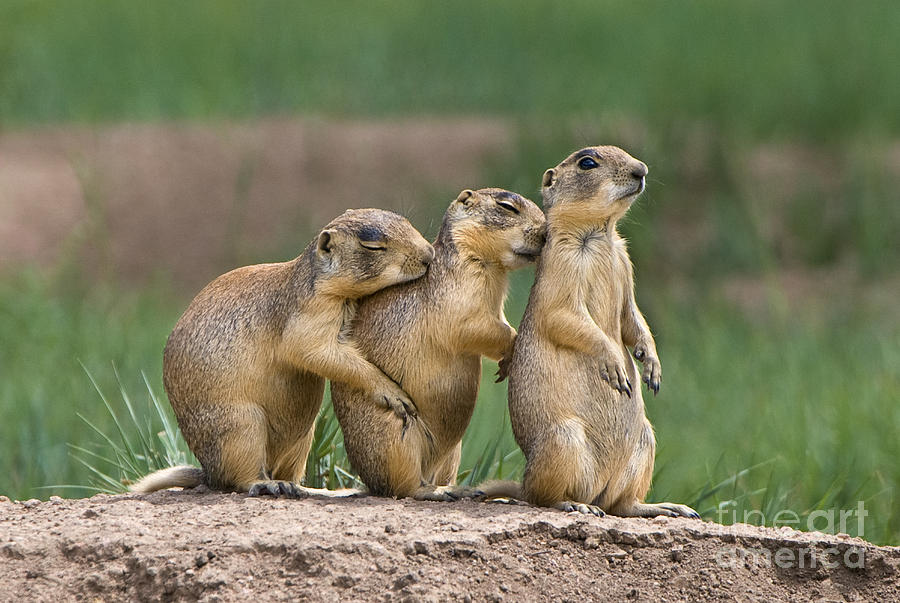
Hey everyone! My name is Larry the prairie dog and I am going to be your guide today. I tell you all about what is going on with my family and the area that we live in. As you can see from this photo on the left, sadly, we are going extinct. I want to be nice to you all today because at the end of the day, it is you humans who are reading this memo that can make the change. There will be an option for you to take action and I ask that you please take it. But before I get too far ahead of myself, let me tell you a little bit about my self.

You wouldn’t think I am a rodent because of how gosh darn cute I am, but in reality I belong to the Sciurid family of rodents. I am one of five prairie dog species that are native to North America; the others being the white tailed, black tailed, Gunnison’s, and Mexican prairie dogs. My family and I are relatives to the white tailed prairie dogs, at one point we were even from the same family, but now there are ecological and physiographic barriers that stand between us so we each have our own family name. There are several ways you can tell us and my cousins apart by how we look, but in general it is best to not discriminate species just on looks. Sometimes it is hard to spot us because we are pretty small animals. We range in height from in 9.8 to 15.7 inches, but the females and males differ in weight as the men are a little bit bigger. For example I will grow up to weigh between 1.7 and 3.1 lbs and my girlfriend (picture of us on right) will weigh between 1.4 and 2.5 lbs, but don’t tell her I told you that, she would be very angry with me. I usually fluctuate in weight depending on the season too, the food is just too good in the summer that I cant control myself so I can put on up to an extra pound. The extra fat also helps us store up for the winter months when we remain mostly underground.


My girlfriend and I want to get married soon and start a family. Right after the winter season is over I am going to propose because most females are sexually active 2 to 5 days after hibernation, and we want to have kids by the end of the next year. We are expecting to have anywhere from 1 to 7 kids in the litter.  Our dream home is in the grouping area of the rest of my family in dry ground that can go up to a meter deep. We also need to live in an area that has good moist vegetation for us and our kids to eat.


Geographic and Population Changes

Before I share how my family is not doing too well, I wanted to tell you about my wonderful home. As you can tell from my name, I am from the wonderful state of Utah. I posted a couple pictures below to show you where my home in South Western Utah once was, and what it is now. 


The picture on the right shows the three areas where my family can mostly be found, and where the recovery efforts are going to make sure we continue on. My homeland has greatly reduced over the last 100 years. The most common threats that caused the loss of my homeland and much of my family are: “habitat loss and fragmentation, plague, changing climatic conditions, unauthorized take, and disturbance from recreational and economic land uses” (USFWS). About 100 years ago my family size was about 95,000! Sadly, we reduced over time until the 1970’s when we were only 3,000 prairie dogs left. Thanks to the recovery efforts that were made we have doubled in size over the last 40 years and now stand about 6,000 prairie dogs tall. Here, take a look at me and all of my friends hanging around my home.


Listing Date and Type of Listing

As I said before, there have been recovery plans made to help my family and I grow back to our old population. We were listed as an endangered species in 1973 with the Endangered Species Act until 1984 when we were reclassified as a threatened species. A formal recovery plan was initiated in 1991 and was recently revised in the last five years to ensure future growth. We are still a threatened species but have a plan and helpers to make us abundant once again.

Cause of Listing and Main Threats to its Continued Existence

I mentioned earlier, when talking about my homeland shrinking, some of the problems that caused my family to get smaller. When we were first listed the U.S. Fish and Wildlife service said we were “threatened with extinction due to habitat destruction and modification, over-exploitation, disease, and predation.” The increase of humans in Utah started to create a lot of problems for our family as they started to build urban areas and farms on our land, causing our habitat to decrease greatly. Habitat loss is very detrimental to who we are. If our homeland becomes fragmented, it is a lot easier for our colonies to crash because there are less prairie dogs in them, and we are very supportive people. However, it is not only humans that are a threat to us. There are invasive plants entering our area that are inedible to us that overtake our food sources. Coyotes, weasels, snakes, and ferrets also all prey on us as well. That is why you often see me in my alert position, looking out for their attack. Well, I am awake, my wife and kids sometimes sleep on the job as seen in the photo. There are also other off-roading vehicles that travel through our homeland and destroy our vegetation.

Description of Recovery Plan

Now lets talk a little about all of the wonderful things that you all are doing for me and my family. Here is an outline of the recovery plan as provided by the USFWS:

1.     Evaluate and update the occurrence and distribution data, maps, and survey efforts for the 
Utah prairie dog across its known range, as information becomes available.
2.     Conserve sufficient acreages and distribution of occupied Utah prairie dog habitat on Federal, State, Tribal, and private lands.
3.     Minimize impacts of diseases to Utah prairie dogs via research efforts, a plague prevention and response plan, and a monitoring strategy.
4.     Develop the capability and implement actions as needed to respond to natural disturbances (e.g., drought, fire).
5.     Continue the translocation of Utah prairie dogs to suitable habitat using approved protocols.
6.     Develop and implement a public outreach program that promotes a better understanding of and appreciation for the biological and habitat values of the Utah prairie dog as well as tolerance of the species.
7.     Develop and implement research priorities to identify and evaluate threats and create tools to expand Utah prairie dog colonies where appropriate to assist with adaptive management and conservation of the species.
8.     Incorporate monitoring into recovery actions to ensure efficacy of actions.

As you can see from this list defining our recovery, most of it focuses on protecting our habitat. We need our land to live a happy and abundant life and it is being threatened by human use. Now that you know how humans are affecting our habitat, let me share with you what can be done to change the situation’

What you all can do to help me

As we are all animals with intrinsic value, I ask that you help us from going extinct. There is already a lot of help going towards preserving the Utah Prairie Dog but there are a couple things that you can do to help. First, is that we need to make sure that properties do not expand into our habitat. There are already laws in place to promote this protection, but you can contact governor Gary Herbert if you hear or see anything that is not in terms with the law: 350 North State Street, Suite 200; PO Box 142220; Salt Lake City, Utah 84114-2220. The next is related, we need to make sure that off-roading vehicles stay in designated areas and do not destroy our homes. More signs can and should be posted around the areas of Utah Prairie Dog habitat to ensure that harmful use of the land does not happen. A letter to the governor for this may be suitable as well.

Learn More
Here are some links to a few different sources where you can learn more about me and my family:


Sources
Google images
U.S. Fish and Wildlife Service. 2012. Utah Prairie Dog (Cynomys parvidens) Revised Recovery Plan. U.S. Fish and Wildlife Service, Denver, CO. 169 pp.
One last photo of me and my brother wrestling….


The San Diego Fairy Shrimp

By Timothy Rowe (nearly forgot to put my name)
Description and Ecology

The scientific name of the San Diego Fairy Shrimp as it is colloquially named is Branchinecta sandiegonensis. It is closely related to the vernal pool fairy shrimp which is Endemic to California and is considered a federally threatened species. It was first identified in 1962. San Diego Fairy Shrimp have large stalked compound eyes, no carapace, and 11 pairs of legs for swimming. Vernal pools are isolated sections of stagnant water in which many diverse plants and animals make their home. However, the isolation caused by the nature of vernal pools makes it difficult to maintain them especially in times of drought. The life cycle that they follow is intricately tied to the wet season. Eggs lie dormant during the dry season and during the wet season, they begin to hatch when water pools around them. They tend to hatch at similar times that germination for vernal pool plants occurs as well which coincides with their food source. They tend to hatch at lower temperatures which protects the species from the possibility of hatching too early during summer storms when not enough water will be available. Also, only a portion of roughly 10% of dormant eggs hatches at a time which protects against accidents due to dehydration. The San Diego Fairy Shrimp matures in only 2 weeks and then females lay anywhere between 100 and 300 eggs which then sink to the bottom of the pools where they also enter a dormant stage to await subsequent wet seasons.


(http://chaparralconservancy.org/wp-content/uploads/2010/09/malesandiego1.jpg)


(file:///C:/Users/Timothy/Downloads/Conservation%20plan.pdf)

Geographic and Population Changes
  They are most commonly found in small, shallow vernal pools, although they have been known to be found in ditches and road ruts with suitable conditions. None have been found in permanent pools of water such as rivers or oceans. They are primarily found in and around San Diego vernal pools but have been found as far south as northwestern Baja California, Mexico and as far north as Santa Barbara. The Santa Barbara finding was only one female in an isolated vernal pool. In Baja California, it has only been found in two locations. Larger deeper pools are more conducive to long term survival of shrimp populations since it protects against the change of pools drying out during warmer seasons.

(http://interwork.sdsu.edu/fire/resources/images/493_Vernal_Pool_II_crop.jpg)
(http://www.californiachaparral.com/images/627_3_16_03_Vernal_Pool_II.jpg)

Listing Date and Type of Listing
They were listed as endangered in 1997 and a plan for their conservation was made in 1998. They have a recovery priority of 2C which indicates that they have a high capacity for recovery but are currently under a large degree of threat. The "C" denotes that their potential for recovery conflicts with the possibility of development projects.

Cause of Listing and Main Threats to Continued Existence
The main threats facing the species were, and still are, habitat destruction caused by agricultural and urban development, draining of wetlands, offroading, cattle grazing, and other fairy shrimp species. which are habitat generalists in comparison. All of these factors have to do with the amount of water available to the shrimp populations. They are heavily reliant on stagnant wet lands to remain stable for long enough periods for eggs to hatch and mature in time to reproduce.

(http://chaparralconservancy.org/wp-content/uploads/2010/09/ProctorValleyPlannedVernalPool.jpg)

For instance, this location used to be a vernal pool, but after being heavily used as an offroad vehicle staging point, the water was dispersed and dried up.


Description of Recovery Plan
The objective of the recovery plan is aimed at conserving and enhancing the Southern California vernal pool ecosystem. Fairy shrimps are an important part of the ecosystem since they are fed on by waterfowl which in turn fertilize the vernal pools and germinate seeds. The overall aim is to reclassify several species from Endangered to threatened which includes the San Diego Fairy Shrimp. The criteria for progression of the recovery plan as laid out in 1998 are as follows:

1. existing vernal pools in a variety of ranges including the LA basin , Orange County, San Marcos, Ramona, etc... that are occupied by endangered species should be protected from further loss and degradation.

2. The existing vernal pools are to be secured in a way that maintains a functioning habitat and viability of species.

3. The secured vernal pools should be restored to population levels that existing species are stabilized or increased,

4. Finally, population levels must be shown to be stable for at least 10 years following reclassification.

Personal Action
The Chaparral Lands Conservancy is an organization currently dedicated to conserving the vernal pools and species of San Diego. Their actions include patrolling imperiled land, setting up fencing, cleaning up trash, and installing signs. Volunteering with their agency is a step you could take through their website http://chaparralconservancy.org or getting in contact with the San Diego council and express your support in the project.

References
http://ecos.fws.gov/docs/recovery_plan/980903a.pdf
http://chaparralconservancy.org/proctor-valley-vernal-pool-restoration/

Save the Ocelot!

by Clarissa Rivas

About the Ocelot
See that cute little face? That is the ocelot, known formally as the leopardis pardalis. The ocelot is a carnivorous cat about twice the size of the average house cat and can live up to 20 years. If you live in the southern regions of Arizona and Texas, it's possible you may have seen this feline roaming around. But considering it's listing as an endangered species, they are becoming rarer and rarer. Thanks to their recovery plan however, the ocelot is hoping to get off of that list and be as strong as they were before their decline.

Ecology and Habitat


The ocelot’s habitat ranges from rainforests, dry tropical forests, savannas, shrublands and marshlands. In Texas, where they are most endangered, they occupy dense thornscrub. The ocelot preys primarily on rabbits, rodents, birds and lizards.


Geographic and population changes

The ocelot resides in areas ranging from southern Texas and Arizona, through Central America, and down into South America into the northern regions of Argentina and Uruguay. The recovery plan states that there are only two populations left in Texas, containing fewer than 50 ocelots between the two. Though they are more abundant in other areas, there are still very few remaining, hence their endangerment. 

Listing date and type of listing
The ocelot was listed as endangered in 1982. The recovery plan began drafting in 1990, and was implemented as of 2010.

Cause of listing and main threats to its continued existence
Habitat fragmentation and loss are the main threats to the ocelots. Because of human population growth and development, 95% of the dense thornscrub the ocelots inhabit in Texas have been converted to agriculture, rangeland, or urbanization. Matrixes between populations of ocelots have also been blocked off by roads and in between Texas and Mexico, the border, causing isolation of populations. Though hunting and trading of ocelots was a big problem back when they were originally listed, thanks to stricter hunting regulations and the Convention on International Trade of Endangered Species (CITES) it is no longer as big of a threat to their existence.

Description of recovery plan
The goal of the recovery plan is to (first) get the ocelot downlisted from endangered to threatened, ultimately getting the ocelot delisted completely. The plan for recovery includes minimizing the effects of human population growth and development in areas where the ocelot resides. We want to improve and restore their habitat, while improving their overall fitness and demographic conditions. We also want to make sure people are more aware of the ocelots and their critical condition, by providing incentives for landowners near ocelot habitats and using public education to teach children the importance of this endangered animal. Even though the plan can only be ensured in the US borders, the recovery plan does include helping and supporting international efforts to conserve the ocelot in other regions, specifically that of Temaulipas and Sonora in Mexico. The total recovery plan is estimated to cost 60,870,500 over the course of 6+ years.
In order for the ocelot to be downlisted, there must be an estimated population of above 200 in Texas, 1,000 in Arizona and 1,000 in Tamaulipas for at least 5 years. In order for the ocelot to be removed from the list of threatened and endangered species, the previous numbers must be held for at least 10 years. Conservationists and management teams are hopeful that if the recovery plan is held up, the ocelot should be downlisted to threatened by the year 2030, and completely removed from the list by 2040.

What can YOU do to help?
One of the most important things you can do, especially if you live in an area where ocelots are found, is to be aware. Do not shoot an ocelot, call your local wildlife center or animal control if they roam onto your private property. Also beware while driving in these areas. Since their populations are separated by roads and highways, they may try to cross these barriers. 
If you do not live in an area close to ocelots, you can adopt one. That is, symbolically adopt one through the the World Wildlife Fund here. It only costs $25, and how cool would it be to say you have your very own ocelot roaming around?


Hopefully we can see the ocelots living abundantly once again, and get them off of the endangered species list! 

References

http://animals.nationalgeographic.com/animals/mammals/ocelot/
http://www.defenders.org/ocelot/what-you-can-do
http://www.nature.org/ourinitiatives/regions/northamerica/unitedstates/texas/explore/mammals-ocelot.xml
To see the full recovery plan, click here.